Every Move You Make: How Keystroke Rhythms and Cursor Paths Are Quietly Building Your Permanent Digital Identity
The Tracking Method That Has Nothing to Do With Cookies
Most privacy-conscious internet users in the United States have by now developed a reasonable playbook: clear cookies regularly, use a reputable VPN, perhaps install a tracker-blocking browser extension. It is a sensible approach, and it addresses a genuine set of threats. What it does not address, however, is an entirely different category of surveillance — one that does not depend on stored files, IP addresses, or login credentials.
Behavioral biometric fingerprinting works by studying how you interact with a device rather than who you claim to be. The rhythm at which you press keys, the precise arc your cursor traces between two points on a screen, the velocity and deceleration of your scroll wheel — these are not random behaviors. They are deeply personal signatures, as distinctive in their own way as the whorls on your fingertips. And they are being harvested, in real time, on an extraordinary number of websites you visit without a second thought.
The Science of Involuntary Signatures
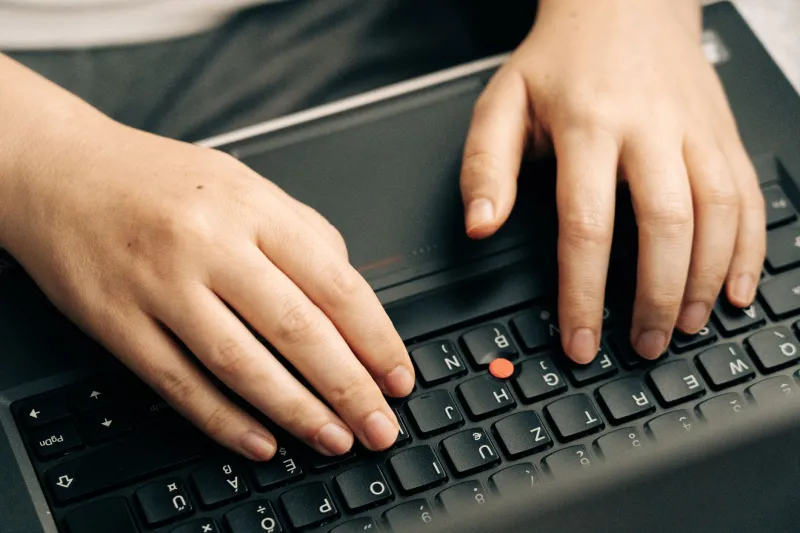
Keystroke dynamics research has existed in academic circles since at least the 1980s, originally explored as a means of strengthening authentication systems. The premise is straightforward: every person exhibits measurable, consistent patterns when typing. The dwell time — how long a key is physically held down — and the flight time — the interval between releasing one key and pressing the next — vary in ways that are largely unconscious and remarkably stable over time.
Cursor dynamics extend the same principle to mouse behavior. The path a user takes to navigate from a navigation menu to a button, the micro-corrections they make mid-movement, the characteristic hesitation before clicking — all of these contain information. Researchers have demonstrated that cursor movement alone can identify individual users with accuracy rates that rival more traditional biometric methods.
Scrolling behavior adds yet another layer. Touchpad users, trackball users, and traditional scroll wheel users each produce different patterns, but within each group, individuals exhibit signatures measurable enough to distinguish one person from another. On mobile devices, the pressure applied by a fingertip, the angle of approach, and the characteristic swipe velocity contribute additional data points to an already dense profile.
When these signals are combined and processed through modern machine learning classifiers, the resulting identifier is not merely accurate — it is, under most real-world conditions, effectively unbreakable by conventional privacy tools.
Who Is Deploying This Technology, and Why
Behavioral biometrics entered mainstream commercial deployment primarily through the fraud prevention industry. Companies such as BioCatch, ThreatMetrix (now part of LexisNexis Risk Solutions), and NeuroID have built substantial businesses around the premise that continuous behavioral monitoring can detect account takeovers, bot activity, and fraudulent transactions in ways that static authentication cannot.
Financial institutions were early adopters. Several major U.S. banks now run behavioral biometric analysis passively throughout an authenticated session — not merely at the login screen, but during every interaction thereafter. If your typing rhythm or navigation patterns deviate meaningfully from your established baseline, the system flags the session for review. From a pure fraud-prevention standpoint, this is a defensible use case.
The concern arises when the same underlying technology migrates into advertising and analytics contexts. Academic research and investigative reporting have documented the deployment of behavioral fingerprinting scripts on commercial websites entirely unrelated to financial services. In these contexts, the stated purpose shifts from fraud prevention to audience identification and cross-session tracking — precisely the surveillance function that privacy regulations and browser cookie restrictions were designed to constrain.
Because behavioral data is collected through JavaScript running in the browser rather than through stored files, it operates largely outside the frameworks that govern cookie consent. There is no banner asking for your permission. There is no opt-out toggle. The script runs, the data is transmitted, and your behavioral profile is updated.
Why Your Existing Privacy Tools Cannot See This Coming
A VPN performs a specific and valuable function: it masks your IP address and encrypts the traffic traveling between your device and the VPN server. What it cannot do is alter the way your fingers interact with a keyboard. Your keystroke dynamics remain identical whether you are connecting from your home in Chicago or through a server in Frankfurt. The behavioral signature travels inside the encrypted tunnel, arrives at the destination website, and is processed by whatever analytics infrastructure is waiting there.
Browser fingerprinting blockers address a related but distinct problem. They attempt to normalize or randomize the technical characteristics of your browser — screen resolution, installed fonts, hardware specifications — to prevent device-level identification. Some advanced tools extend this to canvas and WebGL fingerprinting. Very few, however, intercept the behavioral event streams that keystroke and cursor tracking scripts depend upon, partly because doing so at the extension level is technically difficult and partly because it would interfere substantially with normal website functionality.
Private browsing modes are similarly irrelevant here. Incognito does not change how you type. It does not alter the arc of your cursor. Clearing your browsing history removes stored data from your local machine; it does nothing to the behavioral profile that has already been transmitted to a third-party analytics server.
The Cross-Device Problem
Perhaps the most consequential aspect of mature behavioral biometric systems is their capacity to link activity across devices — a capability that advertising technology companies have pursued aggressively and that has proven resistant to most conventional countermeasures.
Because your typing dynamics and interaction patterns are properties of you rather than properties of a specific device, they can in principle identify you whether you are using your work laptop, your personal tablet, or a borrowed computer at a public library. Researchers have demonstrated cross-device identification using behavioral signals with meaningful accuracy even when no other linking information is present.
For advertisers, this represents the resolution of a long-standing problem. For privacy advocates and ordinary users who believe that using a different device constitutes a meaningful privacy boundary, it represents a significant and underappreciated threat.
Meaningful Steps in a Difficult Landscape
Honesty requires acknowledging that fully defeating behavioral biometric fingerprinting is not straightforward. Short of abandoning interactive computing entirely, there is no simple configuration change that eliminates the underlying data.
That said, several approaches reduce exposure meaningfully. Browser extensions designed specifically to introduce calibrated noise into JavaScript event streams — altering reported keystroke timing values slightly without breaking site functionality — exist and are worth evaluating. Reducing the number of sites on which you interact with sensitive content, and being selective about which services receive your behavioral data, limits the scope of any resulting profile.
Using a VPN remains important for the threats it does address: IP-based geolocation, traffic interception on unsecured networks, and certain forms of ISP-level monitoring. Understanding what it does not address is equally important. Privacy tools are most effective when users hold an accurate model of the threat landscape they are navigating.
Behavioral biometrics represents a frontier where that landscape has shifted considerably, and where the gap between what most users believe protects them and what actually does has grown wider than many realize. The fingerprint factory is already running. The question is how much raw material you choose to give it.